


Making Sense of the Mess: Why Brand Architecture Is Every Mid-Sized Company’s Hidden Growth Lever

The Nike Lesson, the Citi Merger, and the Chaos That Follows Success
In the mid-1990s, I was a young designer at Nike as the company raced toward $10 billion in revenue. We were building brand guidelines while chasing rapid category expansion—cross-training, basketball, running, tech, lifestyle. It was thrilling until it wasn’t. Somewhere between dozens of sub-labels and an explosion of marketing channels, we reached a breaking point: too many messages, too much inconsistency, and a brand system struggling to support its own momentum.
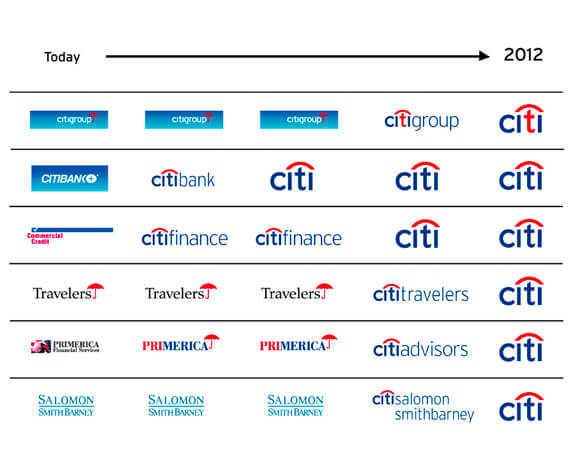
I had witnessed this tension before, during the merger between CitiGroup and Travelers—the largest portfolio consolidation of its time. That project revealed the weight of brand decisions when billions hang in the balance. Which names endure? Which retire? What promise carries the organization forward?
Decades later, I see these same questions arise weekly across midsize companies and nonprofits. The stakes differ, but the cost of confusion is no less significant.
Why Brand Architecture Matters More Than You Think
At its core, brand architecture is the decision-making framework that defines how offerings relate to one another—and to the audience. Done well, it’s an invisible structure that creates clarity, reduces costs, and builds equity. Done poorly, it becomes the reason marketing budgets rise while market share remains stagnant.
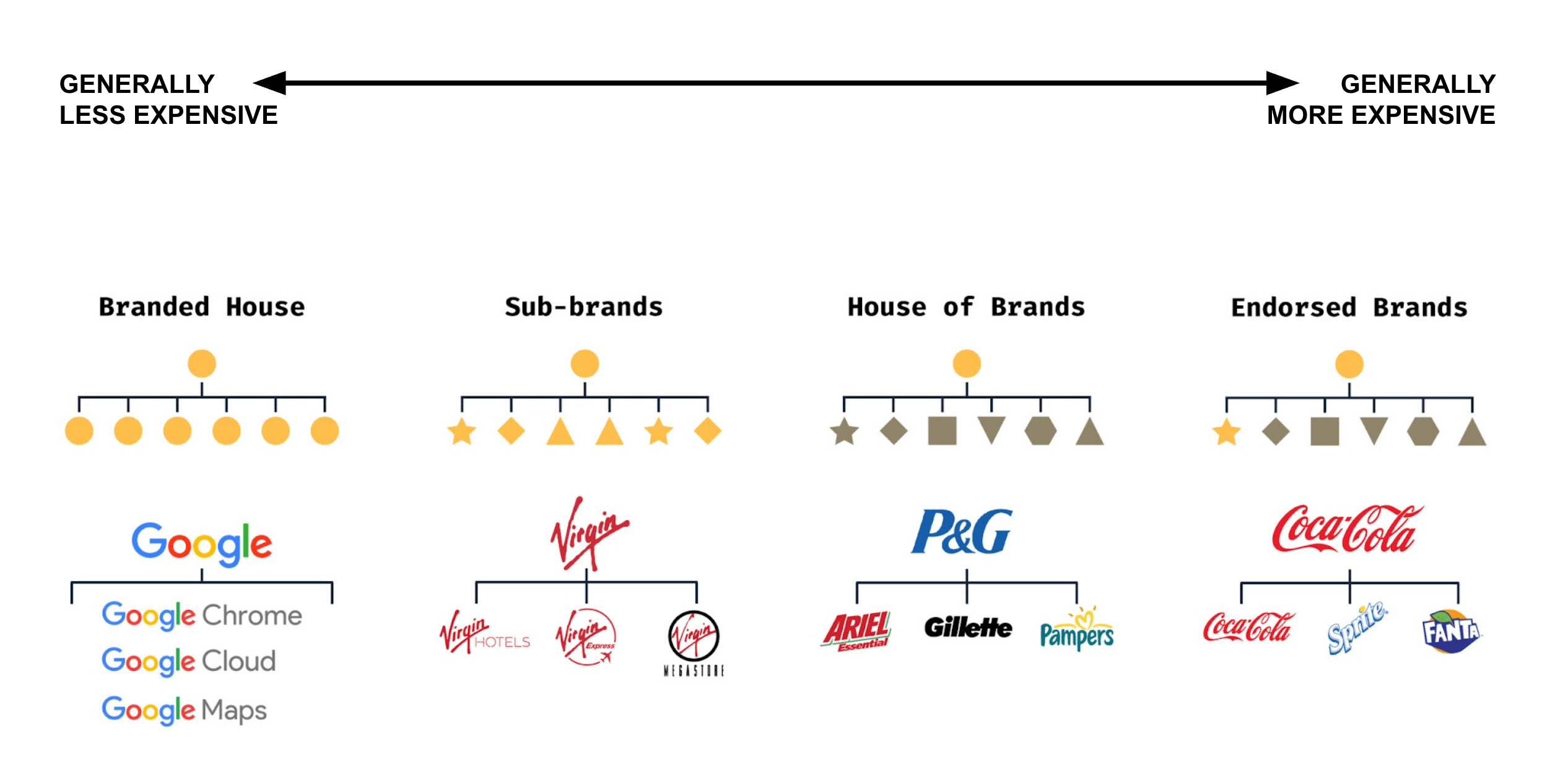
According to Watson’s Brand Architecture Guide (page 2), the most common structures include:
- Branded House (e.g., Google): One master brand with linked sub-offerings such as Chrome or Maps.
- Sub-Brands (e.g., Apple or Virgin): Distinct product identities that still ladder up to the parent.
- House of Brands (e.g., P&G): Independent brands with minimal visible connection to the parent.
- Endorsed Brands (e.g., Coca-Cola): Autonomous brands supported by parent-level equity.





How Watson Approaches Brand Architecture
Brand Architecture for Scalable…
Whether partnering with a national nonprofit like the Autism Society of America or a global manufacturer like ESCO, our approach begins with listening. We conduct audits to understand existing equity, run stakeholder interviews to uncover tensions, and benchmark industries to clarify what’s working—and what’s not.
From there, we evaluate architecture options against real organizational goals:
- Seeking simplicity and faster equity gains? We often recommend a Branded House.
- Serving diverse audiences or geographies? Sub-brands or endorsed structures may provide needed flexibility.
For companies with legacy brands, a House of Brands might be appropriate—but only when the cost and complexity can be justified.
We also identify what should no longer exist: redundant programs, confusing naming, or legacy marks that complicate rather than clarify.
These conversations can be difficult. As a naming firm, we have guided organizations through sunsetting sub-brands, renaming core offerings, or stepping away from long-standing campaigns. But the result is always the same: greater clarity, stronger performance, and teams that finally feel aligned.
Choosing the Right Architecture for a Mid-Sized Business
Brand Architecture for Scalable…
So how do you determine the right direction for your brand system?
Start by asking five essential questions:
- Do audiences understand how your offerings relate—or are they confused?
- Is your current structure helping or hindering your team’s ability to market effectively?
- Are you building one strong brand, or does each offering need its own spotlight?
- Do customers trust the parent brand enough to buy more under its name?
- Do budgets allow for managing multiple brands, or is consolidation necessary?
Uncertainty is common. Many mid-sized companies delay addressing their architecture because they assume it’s a design problem. It isn’t. It’s a business problem—with design implications.
Takeaways: Clarity Is the New Growth Strategy
Brand Architecture for Scalable…
- Brand clarity reduces marketing waste. One voice creates fewer campaigns and amplifies impact.
- Aligned teams move faster. When everyone understands the system, they stop fighting it.
- Customers trust coherence. Confusion is expensive; simplicity earns loyalty.
- Growth without clarity is fragile. You can scale chaos—or you can scale meaning.
Full Circle: From Nike to Now
Brand Architecture for Scalable…
Looking back, the lesson from Nike wasn’t about logos or shoe design. It was about choosing clarity in the midst of growth. The winning teams were those with a focused message, a consistent structure, and the discipline to say no to distractions.
Today, whether working with cities, colleges, or consumer brands, the same principle endures: branding isn’t just how you look—it’s how you organize.
And if your brand architecture isn’t helping you grow, it is almost certainly holding you back.